

Professor of High Performance Computing. Director of the Bristol Centre for Supercomputing (BriCS), including Isambard-AI and Isambard 3. University of Bristol, UK.
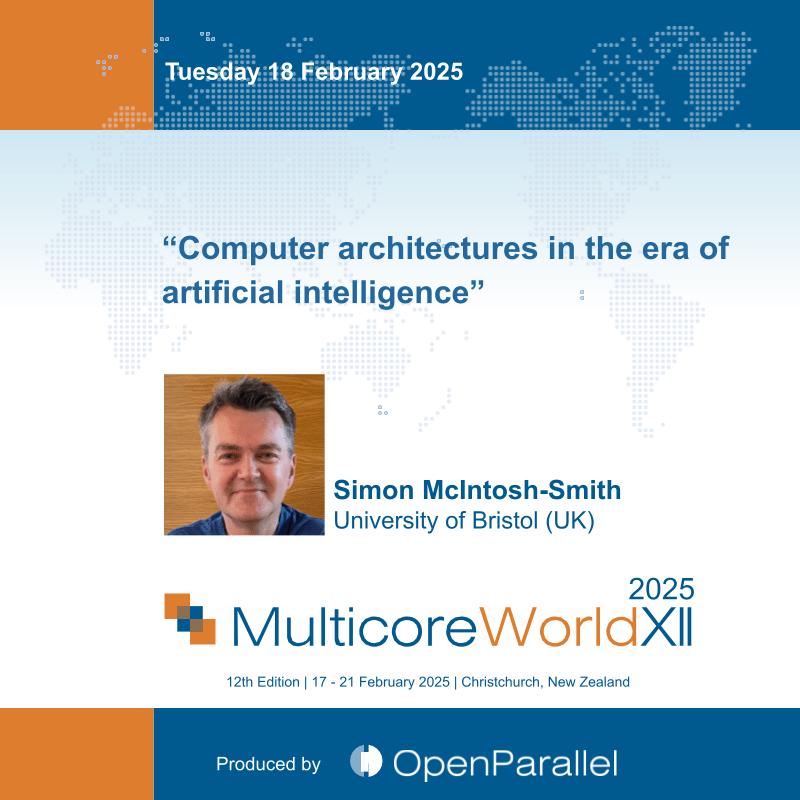
“Computer architectures in the era of artificial intelligence”
18 February 2025
Abstract
Computer architecture as a field has made great strides since the beginning of the field in the 1940s and 50s, with a golden era during the 80s and 90s which saw the dawn of RISC instruction sets, deep pipelines, out of order execution, branch prediction, and deep memory hierarchies. As Dennard Scaling came to an end during the nineties, advances in microarchitecture were largely supplanted by a shift to multi-core, with individual cores advancing at a much slower rate than seen historically. However, in the last five years we have seen a resurgence of innovation in computer architectures, spearheaded by GPUs and GPU like features in CPUs, in response to the enormous economic opportunity created by the AI market. TensorCores and memory techniques designed for sparsity are just two of the many innovations inspired by this phenomenon, but even in high-end CPUs the pipeline widths and depths have also advanced well beyond what was deemed optimal for more general purpose markets.
In this talk we’ll review some of the more important innovations, and discuss the implications of AI driving the computer architecture space so forcefully.
Bio
Professor Simon McIntosh-Smith is the founder and Director of the Bristol Centre for Supercomputing, which runs the UK’s Isambard-AI service. He began his career in industry as a microprocessor architect, first at Inmos and STMicro in the 1990s, before co-designing the world’s first fully programmable GPU at Pixelfusion in 1999. In 2002 he co-founded ClearSpeed Technology where, as Director of Architecture and Applications, he co-developed the first modern many-core HPC accelerators. He previously founded the HPC Research Group in Bristol, where his research interests include advanced computer architectures and performance portability.
 multicore.world