

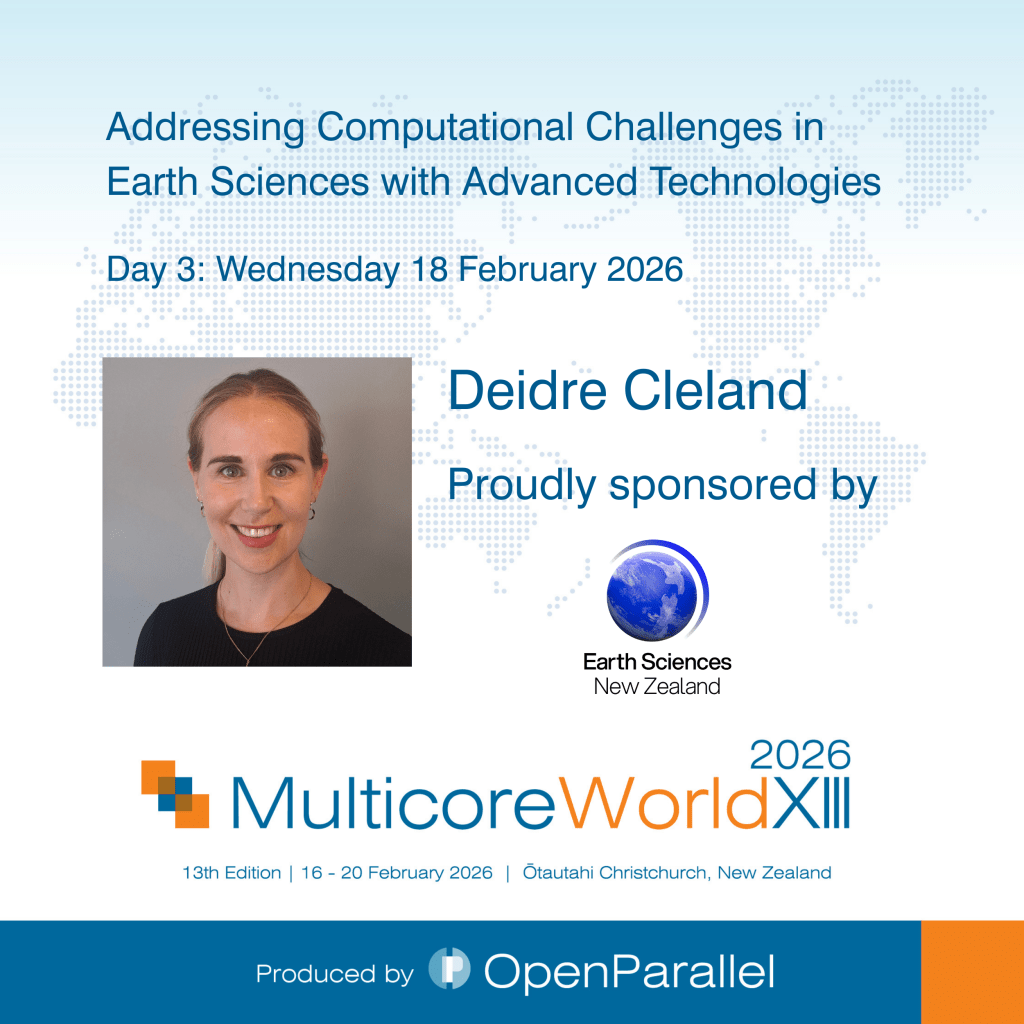
Data Scientist, Earth Sciences New Zealand
“Addressing Computational Challenges in Earth Sciences with Advanced Technologies“
Wednesday 18 February 2026
Abstract
Earth Sciences New Zealand (ESNZ) brings together expertise spanning earthquakes, volcanic hazards, weather forecasting, biodiversity, and energy, land and water resource management, all united by a mission to deliver science that matters for Aotearoa New Zealand. Advanced technologies are increasingly central to translating this breadth of research into real-world outcomes for New Zealanders. We’ll highlight two recent examples that illustrate this technology-to-impact connection. First, we discuss real-time flood impact forecasting, using machine learning to emulate computationally demanding physics-based flood models – work that is already informing how communities receive and respond to flood warnings. Second, we present early investigations into the potential role of quantum computing for Earth science applications, including atmospheric chemistry and data assimilation optimisation problems.
Bio
Dr Deidre M. Cleland is a research scientist in the AI and Deep Learning Team at Earth Sciences New Zealand (ESNZ), New Zealand’s national institute for weather, climate, and environmental research. Her work focuses on applying advanced computational technologies to predict and understand weather related impacts. Her research spans challenges ranging from flood forecasting and urban drainage overflow prediction, to assessing weather impacts on tourism and business operations, and tracking greenhouse gas emissions through the atmosphere. She also leads recent investigations into the state of quantum computing for application to Earth Sciences computational challenges. Prior to joining ESNZ, Dr Cleland was a Research Scientist at CSIRO, Australia’s national science agency, and completed her PhD at the University of Cambridge, where she developed quantum Monte Carlo algorithms to enable accurate quantum chemistry simulations of small molecules.
MW26 Videos
MW26 Q & A
 multicore.world