

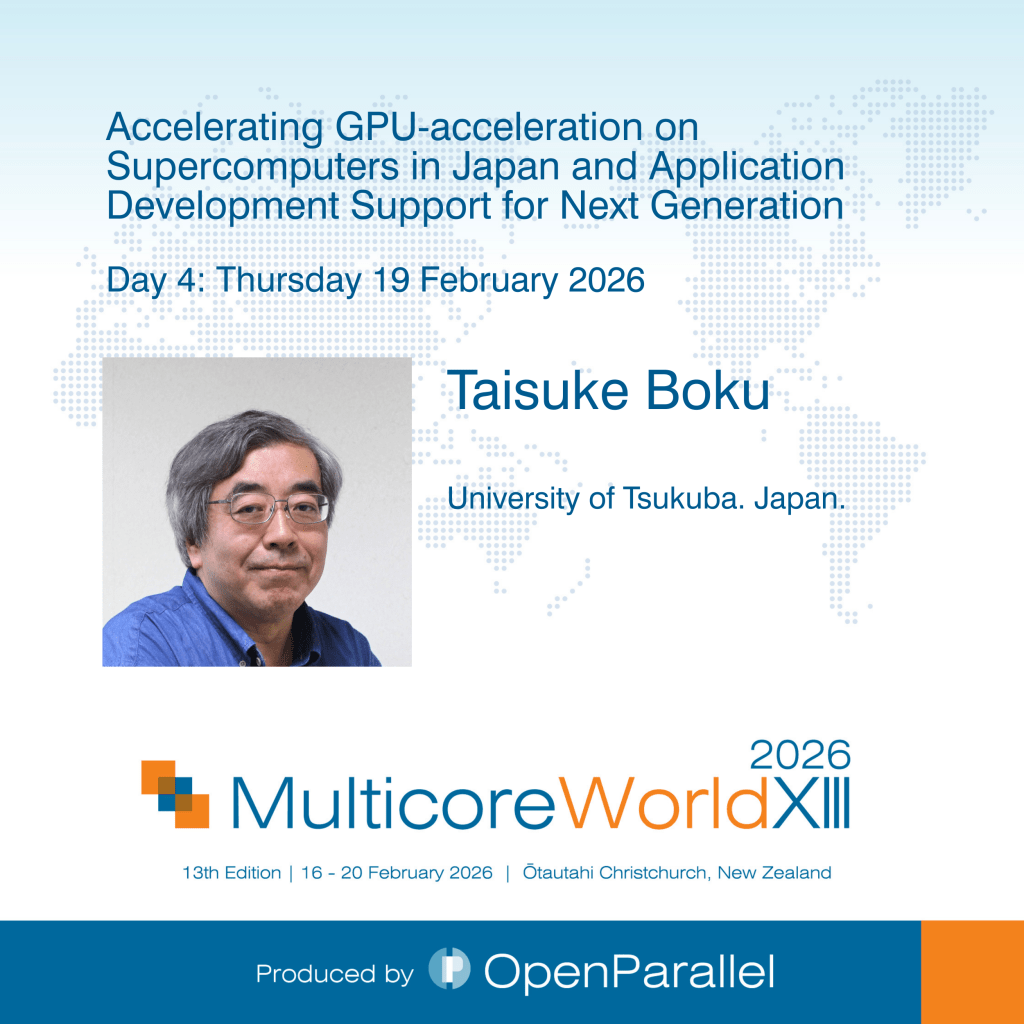
Director, Advanced HPC-AI Research & Development Support Center (HAIRDESC) / Professor, University of Tsukuba. Japan.
“Accelerating GPU-acceleration on Supercomputers in Japan and Application Development Support for Next Generation“
Thursday 19 February 2026
Abstract
In Japan, National Flagship System (NFS) has been developed based on multi-core or many-core general purpose CPU with tens of thousand of computation node as massively parallel CPU systems. According to these systems, the governmental programs for code development and scientific computation promotion has not been mainly supporting accelerated computing such as GPU computing. On the other hand, GPU-ready systems have been introduced in several supercomputing centers in national universities which are categorized as National Infrastructure Systems (NIS) in HPCI, the supercomputer collaborative use framework in Japan. However, the government (MEXT) finally decided to step into GPU computing even with NFS of next generation after Fugaku, under project name of “Post-Fugaku”, and the basic design of the system has been started by RIKEN R-CCS under the code name of “Fugaku-NEXT”, which is based on Fujitsu’s next generation CPU (MONAKA-X) and NVIDIA GPU. Under such a situation, we need rapid code development toward large scale GPU-ready systems both for NFS and NIS, supported by governmental program. Responding to the governmental call, we launched a new national center named “Advanced HPC-AI Research and Development Support Cente”, or HAIRDESC for short, in Kobe Japan. The governmental support for the center is 4.5 years from Oct. 2025 to Mar. 2030, toward the Fugaku-NEXT operation starting plan. In HAIRDESC, we will construct a standard set of GPU coding with wide variation of coding styles, application fields, multiple levels from novice to expertise, and with multiple vendor’s GPUs (AMD and NVIDIA). HAIRDESC is also supported by three core organizations: Univ. of Tsukuba, Univ. of Tokyo and Inst. of Science Tokyo, where top-level GPU researchers gather and operate the largest scale of GPU supercomputers under MEXT.
In this talk, I will present current plan of Fugaku-NEXT (by courtesy of R-CCS) and progress of GPU system installation in NIS centers, followed by HAIRDESC plan and activities including the advanced GPU research at three core organizations. I also talk about the memory architecture system differences in two CPU-GPU coupling technologies, NVIDIA GH200 and AMD MI300A with performance analysis.
Bio
Taisuke Boku has been researching HPC system architecture, system software, and performance evaluation/tuning on various scientific applications. In 2019-2025, He was the Director for Center for Computational Sciences (CCS), University of Tsukuba, a co-designing center with both application researchers and HPC system researchers. He played a central roles for development of original supercomputers in the center including CP-PACS (ranked as number one in TOP500 in 1996), FIRST, PACS-CS, HA-PACS, Cygnus and Pegasus systems, the representative supercomputers in Japan.
He was the President of HPCI (High Performance Computing Infrastructure) Consortium in Japan in 2020-2022, and also currently the Vice President in 2024-2026. He was a member of system architecture working group of Fugaku supercomputer development. He received ACM Gordon Bell Prize in 2011. He was one of the Program Directors of the Feasibility Study of the Next Generation Supercomputer in Japan (“Post-Fugaku”) under MEXT, and also one of the Program Directors of the Program for Promoting Research on the Supercomputer Fugaku.
As well as a professor of University of Tsukuba, he was assigned to the Director of newly established Advanced HPC-AI Research and Development Support Center (HAIRDESC) under a governmental program by MEXT, which supports the education and code development toward GPU-ready systems such as FugakuNEXT and all GPU-equipped supercomputers in Japan.
MW26 Videos
MW26 Q & A
 multicore.world